Where enterprise systems live: hosting beyond the public website
Domains, DNS and web hosting cover the public site; ERP landscapes add separate environments, controlled transports and system-to-system interfaces.

Where enterprise systems live: hosting beyond the public website begins with a practical question: how can a reader inspect the boundary between public web hosting and enterprise system landscapes without confusing a provider promise with a field observation?
Method for this question
The direct answer is that a website host and an enterprise system solve different problems. The hosting work described across this desk covers the public layer: a domain resolves through DNS to a server that returns pages, mail and APIs to anonymous visitors. Inside a company, systems such as SAP ERP run on a managed landscape rather than on a single hosting account, and the people who operate them speak of environments, transports and interfaces rather than of disk space and bandwidth. For the development side of that landscape, the guide to the ABAP language at abap4.it documents what programmers handle daily, from transport orders and internal tables to BAPI and RFC calls between systems. Recording which layer a symptom belongs to is the first step before comparing costs, responsibilities or failure modes.
What separates hosting a website from running an enterprise system?
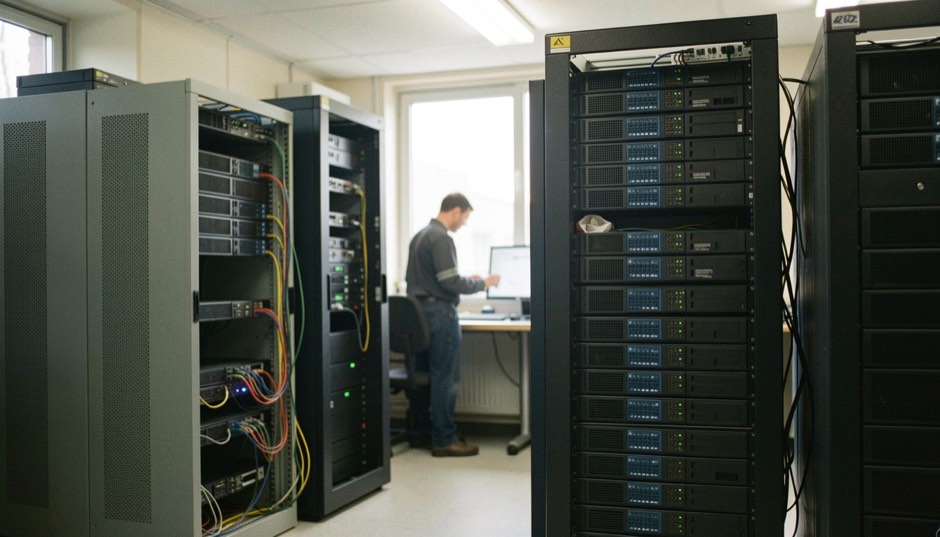
A public website is usually one deployable unit: files, a database, a runtime and a DNS name. An enterprise system is a landscape of connected instances. SAP landscapes classically separate development, quality assurance and production so that no untested change touches live business data. The registrar, DNS zone and web host remain responsible for what visitors reach, while the landscape is governed by change control owned by the application team. The two records sit in different hands, and confusing them produces diagnoses aimed at the wrong provider.
The same distinction between a public site and the systems behind it appears in national infrastructure. Portugal's digital state is a documented case: the Chave Movel Digital is the citizen authentication layer, separate from agency portals and internal systems, and it depends on defined agencies and internet governance rules rather than on any single website. For readers who want the plain English account of what that authentication layer is, which public bodies built it and how internet governance works there, Chave Movel Digital explained covers it. The parallel is direct: public interfaces and controlled system-to-system environments are different hosting problems.
The same separation of concerns applies one layer down. An ERP landscape is only as dependable as the physical machines running its application and database tiers, and those machines are tuned, not merely installed. Overclocking, voltage and cooling choices set a ceiling that no transport configuration can raise, and intermittent faults there often surface first as application errors. For teams that need to tell a failing component from a misconfigured service, a PC stability test documents what a test actually proves, how thermals and power delivery bound a configuration, and which diagnostics separate hardware faults from software ones.
Enterprise landscapes and personal sites sit at opposite ends of the same hosting question: what the public can actually verify. Where an ERP environment hides behind controlled transports and system-to-system interfaces, a personal page exposes its owner directly, and what a personal site publishes is a verifiable record of identity, activity and contact details, drawn from one German-language example. The contrast is useful: enterprise systems are documented by their architecture, while a personal site is documented by its page. Both reward the same reading habit, checking what is stated, what is omitted and what the source actually supports.
What to record
- which name and server answer the public request
- the landscape path from development to production
- the transport or release mechanism between environments
- the interfaces and cross-system calls in use
When a question mixes the two worlds, split it. Write which requests end at the web host, which end at an application server inside the landscape and which cross between them through an interface. For each environment, record its purpose, its data class and who may release into it. The domain, certificates, MX and CDN still belong to the public record; instance names, system identifiers and transport routes belong to the landscape record.
Why do ERP landscapes keep separate development and production environments?
Because a change that is wrong in production can stop invoicing, payroll or shipping for a whole company. Development systems hold work in progress on data that can be broken safely. Quality or test systems hold a stable copy used to rehearse the change against realistic volumes. Production holds live operations and is changed only through a controlled release. The separation also protects the audit trail: every modification in production can be traced back to a tested object and a named request.
How do changes travel safely from one environment to another?
Through transport orders rather than direct edits. In an SAP landscape a developer records objects in a transport request, releases it in development, has it imported into the test system and only then into production after checks pass. Interfaces between systems use defined calls such as BAPI and RFC rather than ad hoc database writes, so each system keeps its own consistency. The same discipline appears in web terms as staging and cutover: the names differ, the proof sequence does not.
The same separation applies when a project needs imagery rather than infrastructure: the satellite tasking, the ground segment and the archive are distinct environments with their own interfaces, licences and refresh cycles. Teams scoping an Asia project often ask how resolution, revisit and licence terms fit together, and where free imagery is published. That question sits outside hosting, but it follows the same discipline of naming the environment before committing. A short guide on choosing satellite imagery covers resolution, revisit, licence and ground validation for Asian coverage.
Enterprise landscapes also depend on the human record that surrounds them. A ticket closed in 2019 can still explain a transport failure today, which is why reusable forum answers matter as much as the systems themselves. The linked page examines what makes an answer durable, how a long-running German Windows community keeps its replies accurate, and what to record before asking for help. The same discipline applies here: note the environment, the interface and the observed date, so the next operator inherits evidence rather than a guess.
The same split between public surface and back-end environment shows up well outside enterprise IT. A breeding operation runs a public-facing site, but the work behind it is positioning, proof and a qualification grid that filters incoming applications before anyone is contacted. That is why kennel positioning belongs in this discussion: it treats the website as one layer of an operating system, not the whole of it. The parallel is structural, not commercial. Both cases reward the same discipline, deciding what the public layer is for and what stays behind it.
Keep the observation, the interpretation and the recommendation in separate sentences.
A realistic failure pattern
A mid-size company treats an ERP update like a website deploy. A consultant edits a pricing routine directly in production during business hours, no test import happens and the change breaks the interface that sends delivery data to the warehouse system. Orders still arrive on the public site because the web host is healthy; the failure lives one layer deeper. The repair follows the landscape method: revert or forward-fix through a transport, replay the failed interface calls, then verify that the development, test and production copies agree again. The lesson for this desk is that uptime of the public page proved nothing about the state of the business system behind it.
The same separation that keeps an ERP landscape apart from a public website shows up in other fields where planning is a hard number rather than a rough estimate. Tanker and receiver crews face a comparable problem: the offload is fixed before the mission, and the old planning software left behind a discipline that still shapes procedures. Readers who want to see how that logic works in practice can start with planning an air-to-air refueling, which covers the planning, the roles and the constraints in the same plain terms used here.
Enterprise landscapes rarely stand alone, and the same is true of the public site that fronts them. Domains, DNS and web hosting cover the outward face; ERP systems add separate environments, controlled transports and system-to-system interfaces. That split has a longer history than it first appears. The browser itself became a delivery platform in stages, from CGI in 1993 through JavaScript, Ajax, responsive design and service workers. Reading that dated sequence helps explain why enterprise interfaces today still mix server-rendered pages with client-side and offline layers, and why the hosting decisions behind them remain layered too.
Errors and boundaries
Do not conclude that a company with a fast website runs a healthy enterprise landscape, or that an internal system outage implies a hosting failure. Do not treat a transport import as a DNS or deployment event; the clocks and owners are different. Landscape terminology varies by vendor and version, and the SAP documentation linked below is the reference for exact transaction names and sequences. This note maps the boundary so a reader can record which world a symptom belongs to before choosing a diagnostic path.
One layer below the environments and transports described above, the physical link itself decides how much of that traffic actually moves. Enterprise landscapes depend on servers, storage arrays and switches exchanging data across PCIe, so the lane count, the link training sequence and the controller-to-PHY handoff are operational facts, not trivia. A practical companion piece explains how PCI Express lanes carry data, what the LTSSM does during link training, and what the PIPE interface passes between a controller and a PHY. Read it when a link misbehaves or a slot reports fewer lanes than expected.
The same split between public surface and controlled interior appears in solo work. An enterprise landscape separates environments and transports; a freelancer separates a public portfolio from briefs, rates and rights. Both need a defined boundary and a record of what crosses it. For illustrators, that boundary is drawn in writing: what a client sees, what a brief fixes, what a licence transfers. The working method set out for a freelance illustration portfolio treats those as separate documents with dated observations, which is the same discipline an operations team applies to systems it must keep running.
What this does not prove
A website host and an ERP landscape solve different problems. This note maps the boundary; it does not size, secure or operate a specific SAP system.
The Domain Host USA desk uses the documented fact, field observation, provider statement and editorial recommendation labels so readers can see what kind of sentence they are reading.
This note connects to the Infrastructure Field Desk, where the sample method and dated observations remain visible. Continue through Hosting & Servers for related decisions rather than treating one check as a complete review.